

Agentic AI as the risk radar for project managers
August 30, 2025Part 3 of our Gen AI for PM series
Intro
Just as pilots rely on a radar to detect turbulence before it hits, project managers (PMs) can now rely on Agentic AI as their risk radar. Instead of waiting for issues to surface in weekly reviews or status meetings, the AI agent continuously scans project data, predicting risks early and raising alerts. This proactive approach ensures that project managers (PMs) can address problems before they escalate, keeping projects on course and stakeholders informed.
Why risk management is still manual in many orgs
Risk management is one of the most critical responsibilities of a project manager — yet in many organizations, it’s still a manual, reactive process.
Here’s how it often plays out: A supplier misses a delivery update. A developer is behind on a sprint task. A budget line creeps higher than expected. None of these issues get noticed until the weekly review meeting, at which point the project is already veering off track.
By then, the PM is in firefighting mode — pulling resources, rearranging timelines, and explaining to stakeholders why things slipped.
But what if risks didn’t sneak up on you? What if you had a radar system scanning your project continuously, flagging issues before they turned into crises? That’s exactly what Agentic AI brings to project management.
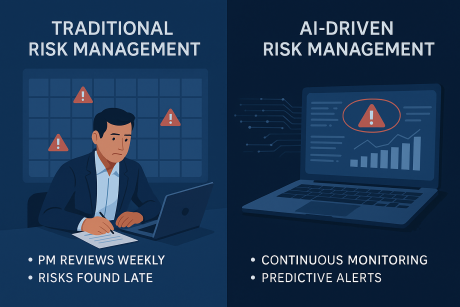
The comparison below highlights the difference between traditional and AI-driven risk management. On the left, project managers manually review risks during weekly check-ins—often discovering issues only after they’ve already caused delays. On the right, AI systems continuously monitor project data, providing predictive alerts so risks are identified early and corrective action can be taken before they escalate.
Section 1: How AI agents scan project data for anomalies
Unlike human PMs who can only process limited information at a time, AI agents never sleep. They monitor all project data streams — tasks, budgets, communications, even IoT data in some industries — to spot anomalies.
In software development: Agents monitor sprint velocity, backlog size, and code check-ins. If velocity drops suddenly, they flag it.
- In supply chain projects: Agents track supplier updates and logistics data. If a shipment is late, they predict downstream impact immediately.
- In construction: Agents monitor workforce schedules and equipment usage, alerting when resources fall below thresholds.
Consider this example: A PM running a global product rollout doesn’t need to wait for a weekly sync. If a supplier in Asia fails to confirm shipment, the AI agent notices within hours and alerts the PM that downstream assembly tasks in Europe are at risk.
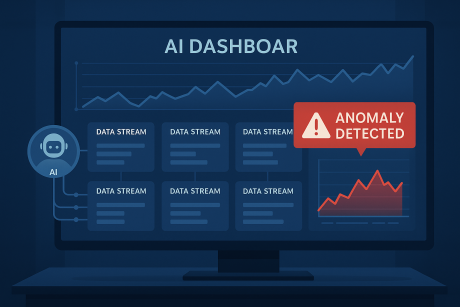
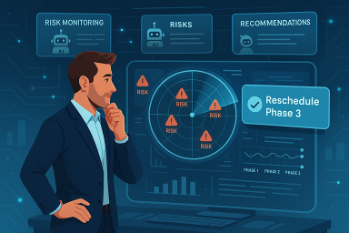
The illustration below shows how the AI dashboard works in real time. Multiple data streams feed into the AI agent, which continuously monitors for irregularities. When an anomaly is detected, the system immediately raises a red alert notification, ensuring teams can act quickly before small issues turn into bigger problems.
Section 2: Predictive alerts for delays or budgetary overruns
Detecting risks is useful. But predicting them? That’s a game-changer.
Agentic AI uses predictive analytics to forecast delays and overspends before they happen:
- If the sprint velocity trend suggests the team won’t finish the backlog, the AI warns the PM early.
- If spending on cloud infrastructure grows faster than expected, the AI projects budget overrun for the quarter.
- If resource bottlenecks emerge, the AI highlights the likelihood of milestone delays.
Consider this example: In a software project, the AI forecasts that the team is likely to miss the sprint deadline by three days. The PM gets the alert a week in advance and reallocates a senior developer to the critical path — preventing a late delivery.
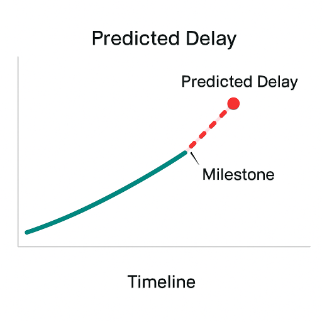
The illustration below shows how AI helps anticipate project delays before they happen. The red dotted line marks a predicted delay, flagged ahead of the actual milestone, giving teams enough time to adjust plans and keep the project on track.
Section 3: Scenario simulation & “What-If” planning
One of the toughest parts of risk management is deciding how to respond. Should you add resources? Cut scope? Delay the milestone?
Agentic AI helps by running scenario simulations:
- What if we delay Task A by two days? → The AI shows the ripple effect on dependent tasks.
- What if we reassign 2 people from QA to Dev? → The AI shows improved velocity but increased bug risk.
- What if we increase budget by 5%? → The AI shows how much time can be saved with extra contractors.
As an example: In a construction project, AI simulates the impact of moving indoor painting tasks earlier to cover for upcoming bad weather. The simulation shows minimal disruption, so the PM confidently approves the adjustment.
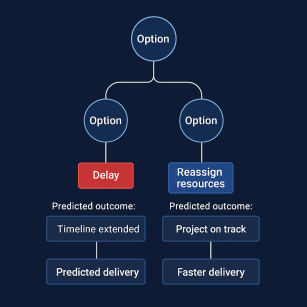
The chart below shows how AI supports decision-making by mapping out different choices and their likely outcomes. For instance, choosing Option A may lead to a delay, while Option B reallocates resources and Option C increases the budget. By predicting the results of each path, the system helps project managers make more informed decisions before committing to an action.
Section 4: Combining AI alerts with human decision-making
Agentic AI doesn’t replace PMs — it augments them.
- The AI surfaces risks quickly and accurately.
- The PM applies judgment — weighing culture, stakeholder politics, and long-term strategy.
- Together, they make faster, better decisions.
As an example: An AI agent alerts that overspending is likely in a marketing campaign. The AI suggests reducing ad spend in underperforming channels. But the PM knows the client values brand visibility over efficiency, so they adjust strategy to meet both the AI’s warning and the client’s preferences.
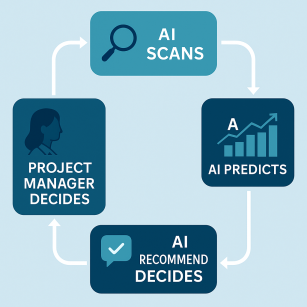
The decision-tree diagram below shows how decision-making is shared between AI and human project managers. The AI first scans data, then predicts outcomes, and finally recommends actions. At that point, the project manager makes the final decision, combining AI-driven insights with human judgment. This loop ensures faster, smarter, and more reliable project decisions.
Conclusion: Risk management shifts from reactive to proactive
For too long, risk management has been about looking backward — filling out risk logs, updating registers, and reacting when things go wrong.
Agentic AI flips the model:
- Risks are detected early.
- Delays and overspending are predicted, not discovered too late.
- Scenarios are tested instantly, helping PMs choose the best response.
Instead of firefighting, PMs become strategic leaders, steering their projects with foresight. The ones who embrace AI won’t just manage risks — they’ll manage confidently, proactively, and with influence.
Key takeaway
Agents give PMs foresight, not just hindsight — transforming risk management into a proactive, always-on discipline.
Related
Agentic AI in agile: Smarter sprints, faster retros
Sep 5, 2025AI agents as the meeting whisperers
Sep 9, 2025Your new PM assistant: The rise of Agentic AI in daily task management
Aug 27, 2025Multi-agent systems for multi-stakeholder projects
Aug 30, 2025From Gantt charts to Generative AI: How Agentic AI is revolutionizing project management
Aug 27, 2025