

Your new PM assistant: The rise of Agentic AI in daily task management
August 27, 2025Part 2 of our Gen AI for PM series
Intro:
Project managers juggle endless moving parts—status updates, task assignments, shifting priorities, and the constant chase for clarity. Too often, valuable time is wasted just piecing together information, instead of driving decisions forward.
This is where Agentic AI begins to change the game: by streamlining updates, automating repetitive follow-ups, and surfacing the insights you need, right when you need them.
The endless cycle of updates
If you’ve ever been a project manager, you know the drill. You open your inbox in the morning, and it’s flooded with updates: “Task delayed,” “Waiting for approval,” “Who’s picking this up?” Then come the Slack pings, calendar invites, and those dreaded status meetings.
By lunchtime, you’ve spent more time chasing information than making decisions. And still, you find yourself sending the same email you’ve typed a hundred times before: “Where are we on this
This is the reality of traditional project management — too much manual overhead, not enough time for leadership. But things are changing. With Agentic AI, task management is no longer a reactive grind. It’s becoming proactive, automated, and intelligent.
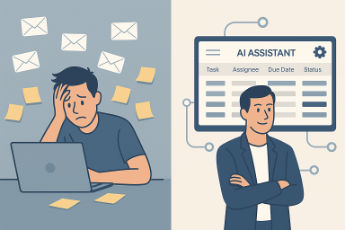
An overwhelmed PM surrounded by emails and sticky notes (left) or one who is calm, cool, and collected, as a result of an AI assistant automatically updating tasks(right).
Section 1: Agentic AI for task allocation and reminders
Allocating tasks sounds simple, but in practice, it’s a juggling act. You need to balance skills, availability, deadlines, and workload. Traditionally, that means spreadsheets, endless emails, and lots of guesswork.
With Agentic AI, this process becomes effortless.
- Skill-based allocation – AI matches tasks to the right team members based on expertise and bandwidth.
- Load balancing – If someone is overbooked, the AI reallocates tasks automatically.
- Smart reminders – Instead of the PM chasing, AI sends nudges when deadlines are near.
Consider this example: Sarah, a PM, notices that her developer John already has three critical tasks. Instead of assigning him another bug fix, the AI routes it to Priya — who has the right skills and availability. John stays productive without burnout, and Priya feels trusted with meaningful work.
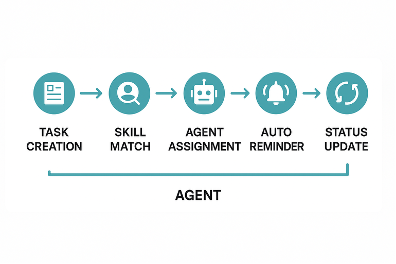
The graphic below shows how tasks move through the AI-driven workflow: They begin with Task Creation, are followed by a Skill Match, then proceed to Agent Assignment. From there, the system ensures follow-through with Auto Reminders and concludes with Status Updates to keep everything transparent and on track.
Section 2: Natural language inputs can trigger automatic task adjustments
One of the most exciting aspects of Agentic AI is its ability to understand plain human language.
Imagine this:
- A developer types in Slack: “Feature A is blocked until the API fix goes live.”
- The AI picks it up, flags “Feature A” as blocked, shifts dependent tasks, and notifies affected stakeholders.
- No PM intervention needed.
Instead of PMs manually updating Jira boards or rescheduling, the AI listens, interprets, and acts in real time.
Consider this Example: During a standup, a designer says, “Wireframes are done, just waiting on review.” Instantly, the AI updates the design task as complete, creates a “Review” sub-task, and alerts the approver.
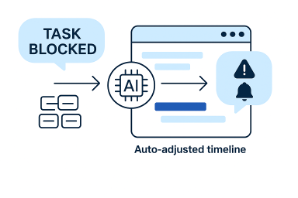
The illustration below shows how the system responds when a task becomes blocked: the AI agent steps in to automatically adjust the project timeline and trigger alert notifications, ensuring the issue is surfaced and addressed without delays.
Section 3: Reducing human error in task tracking
Manual task tracking is messy. People forget to update boards, mark things “done” that aren’t done, or miss dependencies. These errors snowball into delays, missed deadlines, and finger-pointing.
Agentic AI tackles this by:
- Auto-syncing across tools – Updates in Jira, Asana, Trello, or email are reflected everywhere instantly.
- Error detection – If a task is marked complete but the code hasn’t been merged, AI raises a flag.
- Audit trails – Every update is logged for transparency and compliance.
As an example: Without AI, a QA engineer closes a ticket marked “passed,” but the bug reappears in staging. AI catches the mismatch and reopens the task, preventing the issue from being reported late in production.
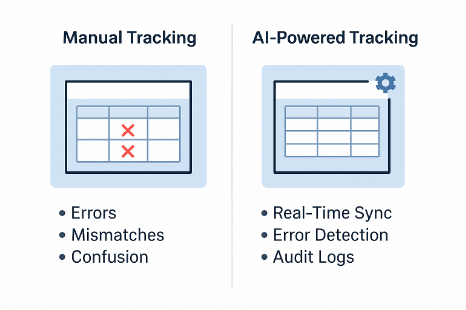
To compare and contrast, consider the image below that shows the differences between manual tracking versus AI-powered tracking.
Section 4: Case Study – 20% time saved in sprint management
At a mid-sized software company, the PM team adopted an AI task assistant to manage sprint planning and daily updates.
After three months, they realized the following results:
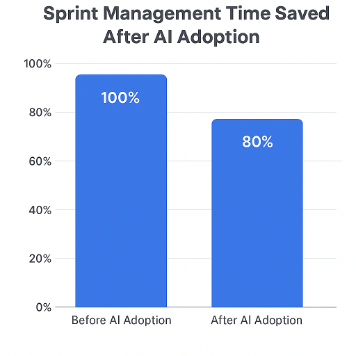
- 20% reduction in sprint management time (less manual backlog grooming, fewer status check-ins).
- 30% fewer status meetings (updates auto-logged by AI).
- Higher developer satisfaction (less time spent on admin, more on building features).
In this case study, we observed that instead of three 1-hour sprint syncs per week, the team only needed one. The AI managed the other updates asynchronously, saving the PMs nearly 8 hours per month.
The bar graph below illustrates the sprint management time that was saved as a result of the adoption of Agentic AI.
Focus on leadership, not micromanagement
Here’s the truth: AI isn’t coming to replace project managers. It’s coming to liberate them.
By offloading repetitive work like task allocation, reminders, and updates, PMs can finally focus on the work that matters most:
- Motivating teams
- Driving strategy
- Building relationships
- Guiding projects toward meaningful outcomes
The next generation of PMs won’t be remembered as task chasers — they’ll be celebrated as strategic leaders powered by intelligent AI assistants.
Key takeaway
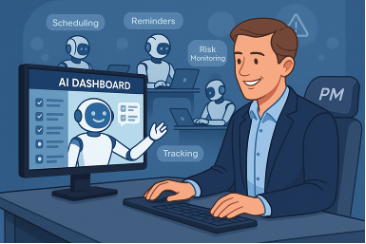
Agentic AI eliminates the “where are we on this?” emails, replacing them with real-time, self-updating project visibility.
Tags
Related
AI agents as the meeting whisperers
Sep 9, 2025Multi-agent systems for multi-stakeholder projects
Aug 30, 2025From Gantt charts to Generative AI: How Agentic AI is revolutionizing project management
Aug 27, 2025
Experimenting with the Model Context Protocol and Chapel
Aug 28, 2025
From generative to agentic AI: Tracing the leap from words to actions
Jul 3, 2025
Part 3: Model Context Protocol (MCP): The protocol that powers AI agents
Jul 18, 2025Part 10: Agentic AI Serving — Hosting agents like LLMs with AGNO Playground
Jul 21, 2025