

AI has come a long way from simply finishing our sentences. Today, it’s not just generating content — it’s actively solving problems, making decisions, and executing complex tasks. This blog post kicks off a 10-part series where I'II trace that incredible journey — from basic generative models to fully autonomous agents. Along the way, I’ll unpack the key shifts, architectures, and mindsets that shaped this evolution.
Inspired by a my post on Medium, this piece reimagines and expands on the original with a human-first lens and practical clarity.
Whether you're an AI developer, tech leader, or just curious about where all this is headed — welcome. Let’s dive in.
Phase 1: LLMs — The linguistic powerhouse
Large Language Models (LLMs) like GPT, DeepSeek, QWEN, and LLaMA burst onto the scene with one incredible skill — understanding and generating human language. These models are trained on massive datasets and excel at:
- Multilingual conversations
- Summarization, classification, and text generation
- Contextual prediction based on vast patterns
But here’s the catch:
LLMs are great at “saying” things… but they don’t do anything.
On their own, LLMs are like brilliant thinkers without hands — capable of deep analysis, but unable to act in the real world.
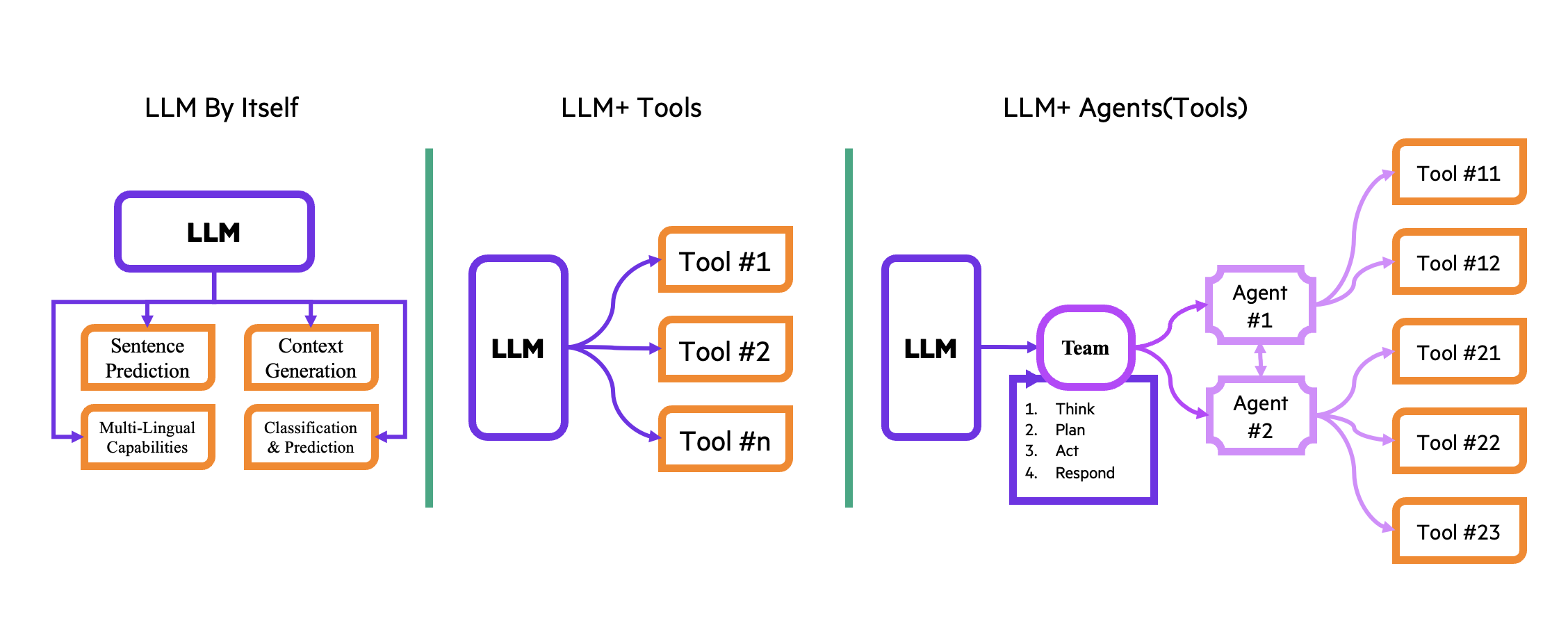
Phase 2: LLMs + Tools — Giving the brain some hands
The next leap came when developers began connecting LLMs with external tools — APIs, plugins, databases, and custom workflows. This simple but powerful integration gave models the ability to:
- Search the web (like Perplexity AI)
- Execute code and commands
- Fetch real-time or contextual information
This expanded what AI could do. Suddenly, the models weren’t just conversational — they became useful assistants.
But there was still a problem:
Tool-based systems are fragile. APIs break, schemas change, and workflows can become unreliable.
Think of it like giving a brain a set of hands — but the hands don’t always listen, or worse, they change shape every other week.
Phase 3: LLMs + Agents — The rise of agentic AI
This is where things get truly exciting.
Agentic AI introduces a new layer of intelligence: autonomy. Instead of the model responding directly to every input, agentic systems:
- Set goals
- Break them into tasks
- Select and operate tools
- Make iterative decisions
- Learn from outcomes
In essence, AI stops being reactive and starts becoming proactive. These agents operate like digital coordinators — orchestrating actions, delegating responsibilities, and adjusting course as needed. They move beyond simple tasks and begin solving complex workflows.
This isn’t just a better assistant — it’s the early form of AI co-workers.
TL;DR Breakdown
- LLMs = Great with words, but passive
- LLMs + Tools = Adds capabilities, but brittle and manual
- LLMs + Agents = Autonomous systems that think, plan, and act
We’ve moved from “talking AI” to “doing AI.”
Conclusion
The shift from generative to agentic AI is more than just a technical upgrade — it’s a philosophical turning point in how we think about artificial intelligence. We’re no longer training machines to just converse with us; we’re teaching them to collaborate, adapt, and even take initiative. Agentic AI is the foundation for everything from self-operating software agents to autonomous business logic.
In the next part of this series, I’ll peel back the curtain on how agentic architectures actually work — the brains behind the autonomy. Until then, consider this: the next time you interact with an AI, it may not just be listening… it may already be planning your next move.
Related

From Gantt charts to Generative AI: How Agentic AI is revolutionizing project management
Aug 27, 2025AI agents as the meeting whisperers
Sep 9, 2025
Experimenting with the Model Context Protocol and Chapel
Aug 28, 2025Your new PM assistant: The rise of Agentic AI in daily task management
Aug 27, 2025Multi-agent systems for multi-stakeholder projects
Aug 30, 2025
Part 3: Model Context Protocol (MCP): The protocol that powers AI agents
Jul 18, 2025Part 10: Agentic AI Serving — Hosting agents like LLMs with AGNO Playground
Jul 21, 2025